
It’s something that comes on slowly for most people. You find yourself reaching for the railing more often. Maybe you’re a little less confident on uneven ground. Or maybe you suddenly notice that turning quickly makes you a bit wobbly.
Balance problems are very common as we age. Though it’s easy to take for granted, staying upright is no simple task. It depends on several systems working together, including your vision, inner ear, muscles, joints, and nervous system. Age-related changes in any of these systems can make balancing seem less automatic than it used to be. Age-related changes are an inevitable part of aging, but significant balance problems and falls don’t have to be.
How Does Your Body Actually Keep Its Balance?
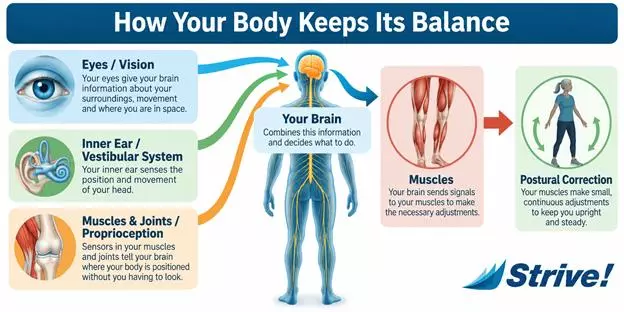
Balance is something that seems simple, something most people don’t think about until it becomes a problem. The truth, though, is that balance is the result of a complex network of systems working together, with your brain constantly combining information from these systems and making tiny corrections to keep you upright. For instance:
- Your eyes tell you where you are. Your vision provides your brain information about your body’s surroundings, orientation, and movement.
- Your inner ear senses movement. Your vestibular system (inner ear) helps your brain detect the position and movement of your head.
- Your muscles and joints share sensory information. Through a process called proprioception, specialized sensors in your muscles, tendons, and joints give your brain information about how your limbs are bent or moving.
Your brain uses this information to inform your body about how to make the constant small corrections needed to maintain balance. This is a complex ongoing process that happens without us realizing it, like a program running in the background every day of our lives.
Why Can Balance Get Worse as We Age?
There is no single answer that will apply to all people. Small, age-related changes in any of these systems can add up over time, eventually leading to reduced stability. Aging can affect muscle strength, vision, reaction times, and more. Balance problems can also result from various medications and/or medical conditions1.
We may lose strength
Aging can lead to decreases in muscle mass and strength, making it harder to maintain posture and recover when knocked off balance.
Our reaction time may slow
Good balance isn’t just about staying stable. It’s also about recovering quickly. If you trip over something or step onto an uneven surface, your nervous system and muscles must respond quickly to keep you upright. Aging can sometimes slow this reaction time.
Our vision may change
Another unfortunate consequence of aging can be a loss of visual acuity, depth perception, or contrast sensitivity. These changes can make navigating steps, uneven surfaces, or low-light environments more challenging.
Inner-ear problems can affect balance
Changes in the inner ear can lead to instability. This is especially likely if your balance problems are associated with a sense of dizziness or vertigo.
Changes in sensation can make it harder to feel the ground
Changes in physical sensation, or proprioception, in your feet and legs can interfere with the sensory information needed to maintain balance. The Mayo Clinic cites peripheral neuropathy (nerve damage) in the legs as a cause of balance problems2.
Aside from the impact of the natural physical changes that occur with aging, many older adults are prescribed medications for various disorders: high blood pressure, anxiety, chronic pain, etc. Sometimes these medication, or combinations of them, can contribute to dizziness, drowsiness, vision changes, or other effects that can cause balance problems. The CDC sites medication as one of several factors that contribute to the serious risk of falling in our elderly population3.
Are Balance Problems Inevitable as We Age?
Some of the physical changes that can contribute to balance problems are an inevitable part of aging, but frequent balance problems and falls are absolutely not inevitable. Unfortunately, falls are a leading cause of injury and hospitalization among older Americans, and many of these falls are preventable.
Balance is something that can be trained, meaning we all have some control over this aspect of aging. Maybe muscles lose mass and get weaker as we age, but we can work to build and maintain strength. Building strength in your legs, hips, and trunk make it much easier for your body to control its movement and recover from small losses of balance.
We can also train ourselves to adapt to different tasks if balance becomes a concern. If we regularly practice and train our bodies to balance and maintain stability in different situations, our nervous systems can adapt. We can intentionally train our bodies by practicing different things like:
- Narrowing our base of support
- Shifting our weight
- Standing on one leg
- Stepping in different directions
- Turning
- Changing surfaces
- Combining movement with another task
Keeping our bodies healthy and trained for different tasks can go a long way toward maintaining our stability and avoiding falls as we age.
Important note: A person already experiencing significant instability or falls shouldn’t begin challenging balance exercises without appropriate support or professional guidance.
When Should Balance Problems Be Checked by a Doctor?
Any balance problems that develop may be reason enough to schedule a doctor’s appointment. This is especially true for balance problems that are new, unexplained, worsening, recurring, or interfering with your normal activities.
The Mayo Clinic recommends seeking emergency care if you experience “new, severe dizziness or vertigo” accompanied by other symptoms like severe head or chest pain, weakness/numbness in the arms or legs, trouble breathing, fainting or seizures, double vision, or sudden hearing changes4.
In most cases, the types of slow-developing balance problems that sometimes accompany aging are not a cause for emergency care. They are, however, a very good cause for working on building your strength and training your body. You don’t want to wait until you’ve fallen and injured yourself to take balance problems seriously.
If you find yourself feeling less steady, reaching for support more often, avoiding certain activities, or feeling more worried about falling, these are all changes worth addressing. Facing these changes head-on is a great way to ensure you age with grace, stability, and confidence.
Sources
- National Institute of Aging. “Older Adults and Balance Problems.” National Institute on Aging, 12 Sept. 2022, https://www.nia.nih.gov/health/falls-and-falls-prevention/older-adults-and-balance-problems.
- Mayo Clinic. “Balance Problems – Symptoms and Causes.” Mayo Clinic, 2018, https://www.mayoclinic.org/diseases-conditions/balance-problems/symptoms-causes/syc-20350474.
- CDC. “Pharmacy Care (STEADI-Rx).” STEADI – Older Adult Fall Prevention, 16 May 2024, https://www.cdc.gov/steadi/hcp/clinical-resources/pharmacy-care.html.
- Mayo Clinic. “Dizziness: Symptom Causes.” Mayo Clinic, https://www.mayoclinic.org/symptoms/dizziness/basics/causes/sym-20050886. Accessed 10 Sept. 2026.


