

Sometimes our legs can get fatigued from doing things like playing sports or climbing a long flight of stairs. Sometimes, though, leg weakness can occur without an obvious cause. Maybe you suddenly notice some shakiness when standing from a chair. Or maybe your legs feel especially heavy during a walk you’ve taken dozens of times before.
Unexpected leg weakness can be alarming, and it can definitely cause problems in your ability to perform basic tasks. It can also be a symptom of an underlying problem that you should address. How significant it is may depend on how it feels, when it occurs, whether it affects one or both legs, and whether it’s accompanied by other symptoms.
What Does the Leg Weakness Actually Feel Like?
A person experiencing what they call leg “weakness” may be referring to one of several possible types of sensations. The type of sensation you’re experiencing can provide important clues both to you and any medical professional you may be seeing about it. For example:
- Muscle fatigue or heaviness
Legs can feel tired, heavy, shaky, or exhausted, especially after activity. This does not necessarily indicate a true loss of muscle strength or “weakness”, even though the experience may cause you to describe it that way. - True muscle weakness
True weakness means your muscles cannot generate their usual force. Maybe you have trouble standing from a chair without using your arms, or you struggle climbing stairs that are ordinarily no problem. - Weakness accompanied by other symptoms
Sometimes muscle weakness may be accompanied by other symptoms like numbness, tingling, or pain. This can be important information to provide to any health care provider.
Whether your legs simply feel weak or are experiencing a true loss of strength, the symptoms may be caused by several different underlying conditions, including problems affecting the muscles, nerves, or metabolism1.
Some Common Reasons Your Legs May Feel Weak
Symptoms of muscle weakness, or the sensation of muscle weakness, can have many different causes. Keep in mind that while your symptoms can provide useful information about potential causes, a real diagnosis requires a real medical professional. With that in mind, some of the more common causes of reported muscles weakness include:
- Fatigue or overexertion
Strenuous exercise, prolonged standing, and unfamiliar physical activities can temporarily fatigue leg muscles. These symptoms will often improve with recovery time. - Muscle weakness from inactivity
Extended periods of sitting, bed rest, or reduced physical activity can contribute to loss of muscle strength and endurance. This process is commonly called deconditioning, and can improve with increased activity and gradual strengthening. - Nerve compression or irritation
Conditions affecting nerves and nerve roots may impact your body’s ability to send signals from the brain and spinal cord to the leg muscles. Symptoms may include radiating pain, tingling, or numbness. This is sometimes associated with conditions like scatica2. - Poor circulation or vascular problems
Reduced blood flow to the leg muscles can cause fatigue, heaviness, discomfort, or weakness-like sensations.This may feel like cramping, aching, or a reduced tolerance for basic activities. - Medical conditions, medications, or nutritional problems
This wide category can include things like dehydration or electrolyte disturbances, anemia and certain nutritional deficiencies, thyroid disorders, diabetes-related nerve problems, or medication-related muscle symptoms. Medical testing may be necessary to identify the cause in these cases. - Age-related loss of muscle strength
Muscle mass and strength often decline with age, particularly when physical activity is limited. Appropriate exercise and other physical activity can play an important role in building and maintaining strength and function as we age3.
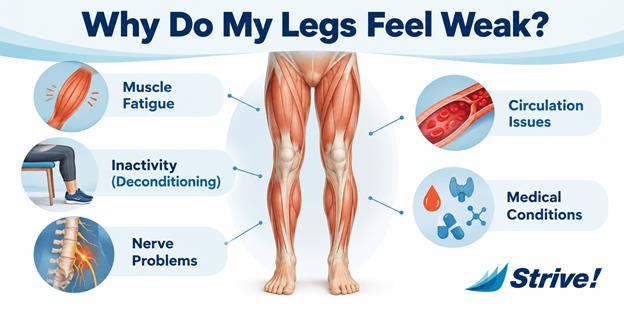
There are many potential causes of perceived leg weakness. This list is not exhaustive and should not be used as a tool for diagnoses. If you are experiencing leg weakness and are concerned about it, see a medical professional for an evaluation.
When Should You Worry About Weakness in your Legs?
If you are experiencing leg weakness that persists over time, recurs, or is generally causing problems with your day-to-day life, getting a professional evaluation and treatment plan is a good idea. In some cases, emergency care is warranted.
Seek emergency medical care for sudden or severe symptoms
Examples include:
- New leg weakness accompanied by loss of bladder or bowel control, numbness around the groin or saddle area, or severe back pain.
- Rapidly progressing weakness, especially with difficulty breathing or swallowing.
- Sudden weakness or paralysis, especially on one side of the body.
- Weakness accompanied by facial drooping, speech difficulties, or sudden confusion4.
Schedule a medical evaluation for persistent or unexplained weakness
Examples include:
- Weakness that continues or worsens.
- Frequent stumbling or falls.
- New difficulty walking, climbing stairs, or standing.
- Weakness with persistent numbness, tingling, or pain.
- Symptoms without an obvious explanation.
It’s best to err on the side of caution with these types of symptoms. Any new or unexplained true muscle weakness deserves a medical assessment. Some temporary “weakness” or fatigue following strenuous activity may just need some recovery time.
Can Physical Therapy Help with Leg Weakness?
In many cases, physical therapy can be a great tool for treating leg weakness, particularly in situations where the weakness is related to deconditioning, certain musculoskeletal conditions, or for rehabilitation. A physical therapist can also be a great source for an initial evaluation to determine the underlying cause of the weakness, and to develop a personalized plan to address the problem.
A qualified PT can help you:
- Identify movement and strength limitations
A physical therapist may evaluate your lower-extremity strength, balance and coordination, walking mechanics, joint mobility, and more. - Build strength and endurance safely
A personalized treatment plan can include individualized exercises and treatments tailored to your specific needs, abilities, and progress over time. - Improve balance and confidence
Balance and gait training can help address instability and reduce fall risk in some patients when appropriate. - Help you return to everyday activities
A physical therapy program can often help you quickly achieve practical goals like walking comfortably, managing stairs, getting in and out of chairs, and maintaining your independence.
A PT may also evaluate your condition and determine that physical therapy alone is not sufficient. Some medical conditions may require medical treatment before or alongside physical therapy or rehabilitation.
If you are experiencing leg weakness that interferes with your ability to do the things you want to do and live the life you want to live, get professional evaluation as soon as possible. Taking that first step can be the safest and fastest way to get back on your feet again.
Sources
- “Weakness: MedlinePlus Medical Encyclopedia.” Medlineplus.Gov, 2016, medlineplus.gov/ency/article/003174.htm. Accessed 13 Oct. 2026.
- Olinger, Catherine Renee. “Sciatica – Causes & Treatment – OrthoInfo – AAOS.” Orthoinfo.Org, 2026, www.orthoinfo.org/diseases–conditions/sciatica/. Accessed 13 Oct. 2026.
- National Institute on Aging. “Exercise and Physical Activity.” National Institute on Aging, 2025, www.nia.nih.gov/health/exercise-and-physical-activity. Accessed 13 Oct. 2026.
- American Stroke Association. “Stroke Symptoms.” Www.Stroke.Org, American Stroke Association, 2024, www.stroke.org/en/about-stroke/stroke-symptoms. Accessed 13 Oct. 2026.


