
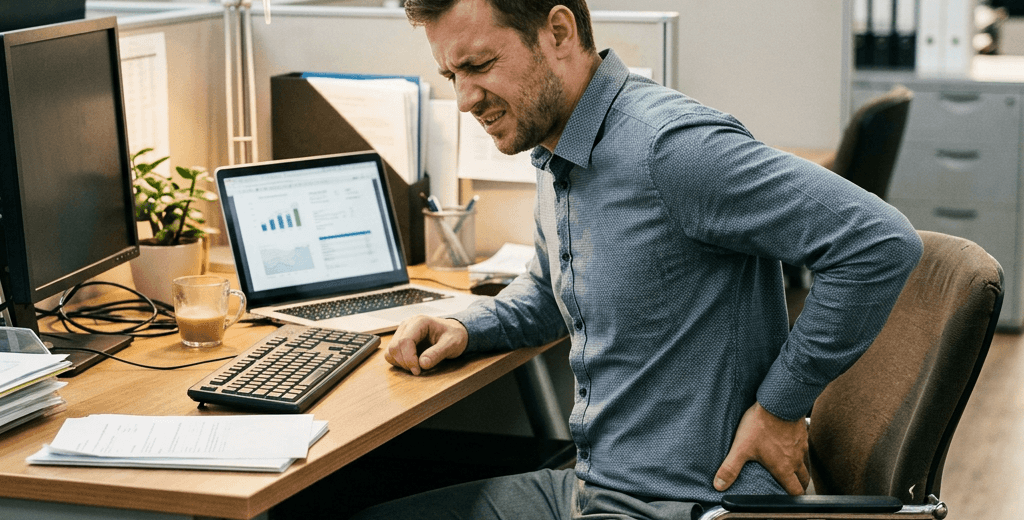
Many people spend at least 8-10 hours a day sitting, whether it’s in a car during a long commute, at a desk during a day of work, or on a couch enjoying a movie. Most of us realize that extended periods of sitting can lead to back pain, but it’s less well-known that prolonged sitting can affect nearly every system in the body.
The human body was designed to move. Without the movement our bodies were designed for, negative effects can ripple through our muscles, joints, circulation, metabolism, and even our mental health. The good news is that understanding these effects can help you make small changes that can have a big impact on your long-term health.
Why the Human Body Was Designed for Movement
Anatomically modern humans can be traced back as far as 300,000 years ago, a number that keeps getting larger as more discoveries are made. For most of that time, our ancestors did much less sitting and much more running, jumping, climbing, carrying, throwing, and many other physical activities. Modern humans evolved as active, mobile creatures. The bodies we inherited from them are composed of muscles, joints, cardiovascular systems, and nervous systems that all depend on regular movement.
Because our bodies were designed for an active lifestyle full of regular physical activity, movement plays an important role in how our bodies function. Movement helps support healthy circulation and the distribution of nutrients throughout the body. Movement also stimulates the production and distribution of synovial fluid, helping your joints stay lubricated and healthy. Movement helps your muscles stay strong and flexible. When we neglect movement, the cost is distributed throughout the entire body.
Movement is so essential to a healthy lifestyle that a lack of physical activity is regularly cited as a significant contributor to chronic health problems, including cardiovascular disease, diabetes, and even some types of cancer1.
The Most Obvious Consequence: Back and Neck Pain
Most of us have experienced some discomfort due to sitting with bad posture or an improperly configured workspace. The forward head posture, rounded shoulders, and unusual pressure on the spine have an obvious connection to pain in our backs or necks. There is a common condition known as “tech neck” associated with modern desk workers. Of course, the issue is not just sitting itself; it’s staying in the same position for extended periods.
Some of this pain can be mitigated by improving ergonomics. Set your desk, chair, and monitor to the correct height. Sit with good posture. Take breaks. All of these things can help, but there is no way around the fact that prolonged sitting is not something our bodies are optimized to do. Even people who prioritize posture and ergonomics can experience neck or back discomfort due to reduced core engagement and postural adaptations that happen gradually over time.
Beyond Back and Neck Pain
Our bodies operate as connected chains of muscles and joints. In fact, pain that is experienced in one part of the body may actually originate from another part of the body. There is a biomechanical concept closely associated with sports medicine known as the “kinetic chain”, which describes the human body as a series of interconnected segments working together to produce movement2.
Some other parts of the body that can be affected by prolonged sitting include:
- Hips and Knees
Extended sedentary periods often contribute to tight hip flexors and reduced glute activation. The limited hip mobility may contribute to altered walking mechanics and put increased stress on the knees and/or hips. - Poor Circulation and Increased Cardiovascular Risk
Inactive muscles can reduce the rate of blood flow and nutrient distribution. Calorie expenditure drops, blood sugar regulation becomes less efficient, and overall cardiovascular health can suffer. - Energy Levels and Mental Well-Being
It may seem counterintuitive, but less physical activity can lead to reduced energy levels. More movement means more blood flow to the brain. Exercise can support concentration and cognitive function, reduce fatigue, and contribute to improved overall mood3.
As mentioned above, there are many health risks associated with prolonged sitting. Of course, sitting itself is not necessarily harmful. The problem is excessive sitting combined with insufficient movement throughout the day.
What You Can Do If Your Job Requires Sitting
Many people have jobs that require sitting, and that doesn’t mean those people are doomed to suffer negative health outcomes. There are some simple things that can be done to mitigate many of the negative consequences. If you must sit frequently, consider trying to:
- Improve your workplace setup
Make sure your monitor is at eye level and that you can work with your feet supported and shoulders relaxed. - Change positions frequently
Avoid staying in one position for hours. Stand up every 30-60 minutes. Maybe incorporate some light stretching. - Take short walking breaks
Even 2-5 minutes of movement can help keep muscles active, joints mobile, and circulation flowing.
Walking, stretching, strengthening, and mobility work can help offset some of the negative effects of sedentary time. Pay attention to your body. If you find yourself experiencing ongoing pain, stiffness, or mobility issues, reach out to a professional for help before small problems become bigger.
The Bottom Line: Your Body Craves Movement
Our bodies were not designed to spend most of the day sitting. Our bodies were designed to move. Unfortunately, many of us lead lifestyles that limit our opportunities for healthy movement, and the effects of prolonged sitting rarely stay isolated to one area. It can contribute to back and neck pain, circulation and cardiovascular issues, energy and mood problems, and more. The body functions as an integrated system, and problems in one area often lead to consequences elsewhere.
If you spend much of your day sitting, some small changes in movement habits can make a big difference for your health. If you are experiencing pain, stiffness, or reduced mobility from your extensive sitting, reach out to a physical therapist for help. A skilled PT can help identify the root cause of your pain (it’s not always obvious) and create a personalized plan to overcome your pain and keep you moving comfortably and confidently.
Sources
- CDC. “Benefits of Physical Activity.” Physical Activity Basics, Centers for Disease Control and Prevention, 2024, www.cdc.gov/physical-activity-basics/benefits/index.html.
- Almansoof, Haifa Saleh, et al. “Role of Kinetic Chain in Sports Performance and Injury Risk: A Narrative Review.” Journal of Medicine and Life, vol. 16, no. 11, 2023, pp. 1591–1596, pmc.ncbi.nlm.nih.gov/articles/PMC10893580/, https://doi.org/10.25122/jml-2023-0087.
- Harvard Health Publishing. “Exercise Is an All-Natural Treatment to Fight Depression – Harvard Health.” Harvard Health, Harvard Health, 21 Feb. 2021, www.health.harvard.edu/mind-and-mood/exercise-is-an-all-natural-treatment-to-fight-depression.


