

You reach into a kitchen cabinet and suddenly there’s a sharp pain in your shoulder. Or maybe it happens when you’re trying on a new shirt or simply brushing your hair. Or maybe the pain isn’t really sudden at all. Maybe you know it happens all the time, but you forget about it until the next time you raise your arm and get a reminder.
A shoulder that feels perfectly normal in most situations but hurts when the arm is raised is a very common complaint. It’s usually not a serious injury. A complex network of muscles, tendons, and joints work together to help you lift your arm, and inflammation or irritation in any part of this system can cause pain. When and where the pain occurs, as well as whether the pain is accompanied by other symptoms like weakness or stiffness, can provide some useful clues about what may be causing it.
Why Raising Your Arm Puts So Much Demand on Your Shoulder
Your shoulder isn’t like a simple hinge on a door. It’s a complex joint that has to move in different directions at different angles under different loads. When you move your shoulder, you are engaging a full system of body parts that includes:
- The humerus (upper arm bone)
- Scapula (shoulder blade)
- Clavicle (collarbone)
- Rotator cuff muscles and tendons
- Deltoid
- Bursa
- Shoulder capsule
- Acromioclavicular (AC) joint
Think of your scapula, or shoulder blade. When you raise your arm, it has to move too. You can notice it rotate slightly and move along your rib cage. Muscles around your shoulder blade and rotator cuff help control the head of your humerus while other muscles work to elevate your arm. All of the muscles, tendons, cartilage, and bones involved are essential to making this movement comfortable and effective. If any one part of this complex system is compromised by damage, or even weakness, it has an impact on all the other parts.
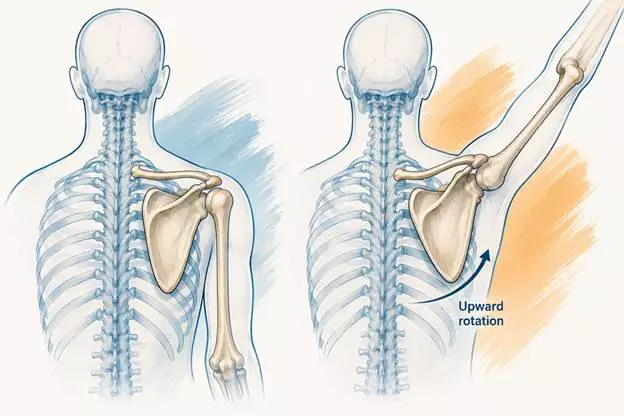
It’s the complex and inter-related nature of these body parts that make it hard for you to diagnose exactly what caused the pain and what may be the best way to treat it. There are some common culprits, though.
Common Reasons Your Shoulder Hurts When You Raise Your Arm
Keep in mind that the purpose of the article is purely educational. It is not intended as a tool for you to diagnose your shoulder pain. That should be something you address with a qualified physical therapist. With that in mind. Let’s look at some of the more common causes of this type of pain.
- Rotator Cuff Tendinopathy or Irritation
Your rotator cuff consists of four muscles and their tendons that help stabilize and move your shoulder. These tendons can be irritated by sports, heavy lifting, repetitive overhead movements, sudden changes in activity, or age-related changes. Symptoms can include pain when reaching overhead or behind your back, or tenderness in your shoulder. Fortunately, these types of rotator cuff problems often respond very well to physical therapy1. - Shoulder Bursitis
A bursa is a small, fluid-filled sac that cushions bones, tendons, and muscles around joints to reduce friction during movement. Inflammation of the bursa (bursitis). When irritated bursa beneath your acromion (the bony bump at the top of your shoulder). Can become painful. Symptoms often include a dull ache while at rest, or a sharp or pinching sensation when the arm is lifted overhead2. - A Rotator Cuff Tear
A more serious rotator cuff problem can be a full or partial tear. In this case, pain is often accompanied by noticeable weakness and difficulty raising your arm. It’s important to keep in mind that these symptoms do not necessarily indicate a rotator cuff tear. However, tears do become more likely with age, falls, sudden pulling or lifting injuries, or repetitive overhead movements. Many people think surgery is the only way to effectively treat a rotator cuff tear, but that is not always the case3.
These are just a few examples of some common causes of shoulder pain. Your shoulder pain may not be any of the above. Often, shoulder pain will go away over time with rest and gentle movements. If it doesn’t, you should consider reaching out to a medical professional for an evaluation.
How Does It Matter When My Shoulder Hurts as I Raise My Arm?
This is less obvious than how the type of pain you feel matters, but the timing of the pain can also provide important clues. For instance, some people will feel pain only partway through raising their arm. It may feel fine at first, then hurt through the middle portion of the movement, then feel fine again once the arm reaches higher. This pattern is commonly associated with irritation around the rotator cuff or subacromial space.
Other people may feel the pain mostly when the arm is all the way overhead. This is especially common for people engaged in occupations like painting or construction, or for athletes who swim, play tennis, or lift weights.
Sometimes people feel more pain when lowering their arm than when lifting it. This can also be a symptom of irritation around the rotator cuff. If you experience this sort of pain accompanied by difficulty controlling your arm, that may be a good reason for a medical assessment.
What If My Shoulder Pain is Accompanies by Stiffness or Weakness?
Another common shoulder condition is adhesive capsulitis, or frozen shoulder. This is different from many of the problems discussed above, because the loss of movement itself is a major symptom. This is a condition that can make it hard to raise your arm, reach behind your back, or do simple daily tasks like get dressed or wash your hair.
The limited motion in this situation is not just because it hurts too bad to move. It is a real physical restriction in your shoulder’s ability to move. As is the case with most conditions, if your shoulder pain is accompanied by additional symptoms like weakness or stiffness, and it is having a real impact on your ability to perform basic tasks, your should get a professional evaluation. Addressing the issue early can play an important role in how quickly and completely you recover.
Other Causes of Shoulder Pain
There are many other things that can play a role in how your shoulder feels when you move it. As stated above, the shoulder is a complex system made of many parts working together. Sometimes, conditions in other parts of your body, like your neck, can feel like shoulder pain to you. It’s not uncommon for shoulder pain to be referred pain from your cervical spine, another complex system composed of many other parts working together.
Another cause of this type of pain is arthritis. Shoulder arthritis can cause pain with activity and is sometimes accompanied by stiffness or reduced range of motion. This is also often accompanied by grinding, catching, clicking, or popping in the shoulder.
When to Seek Help
Many times, shoulder pain will go away on its own and is not something to be concerned about. Sometimes, though, getting a medical evaluation is important. So how do you know the difference?
(An important note: emergency medical attention may be needed if your shoulder pain is accompanied by chest pressure/tightness, difficulty breathing, sweating, or other potential heart-attack symptoms.)
As is the case with most pain, if it doesn’t improve over time, or if it keeps recurring without any additional irritation, it’s smart to get a professional evaluation. If you experience pain that interferes with your work, sleep, exercise or daily routines, a professional evaluation may help you get back to those activities as quickly as possible.
If your shoulder looks deformed, or if you experience severe pain following a trauma like an accident, medical attention is not only recommended but should be an immediate priority.
If you think your pain may merit an evaluation, your best option is to find a qualified physical therapist. They can provide a thorough evaluation that will help reveal the underlying cause of the pain rather than just treating the symptoms. Addressing the pain at its root will provide the safest and most effective treatment option, often helping you avoid pain medication or surgery.
A physical therapist can create a personalized treatment plan to address your pain and also help you build strength, flexibility, and mobility around the injured area, making future injuries less likely and helping you move and feel better every day.
Sources
- Mayo Clinic. “Rotator Cuff Injury – Symptoms and Causes.” Mayo Clinic, 11 May 2023, https://www.mayoclinic.org/diseases-conditions/rotator-cuff-injury/symptoms-causes/syc-20350225.
- Cleveland Clinic . “Shoulder Bursitis: What It Is, Symptoms & Treatment.” Cleveland Clinic, 11 May 2021, https://my.clevelandclinic.org/health/diseases/21530-bursitis-in-shoulder.
- NYU Langone Health. “Nonsurgical Treatments for Torn Rotator Cuff.” Nyulangone.Org, https://nyulangone.org/conditions/torn-rotator-cuff/treatments/nonsurgical-treatments-for-torn-rotator-cuff. Accessed 1 Sept. 2026.

