
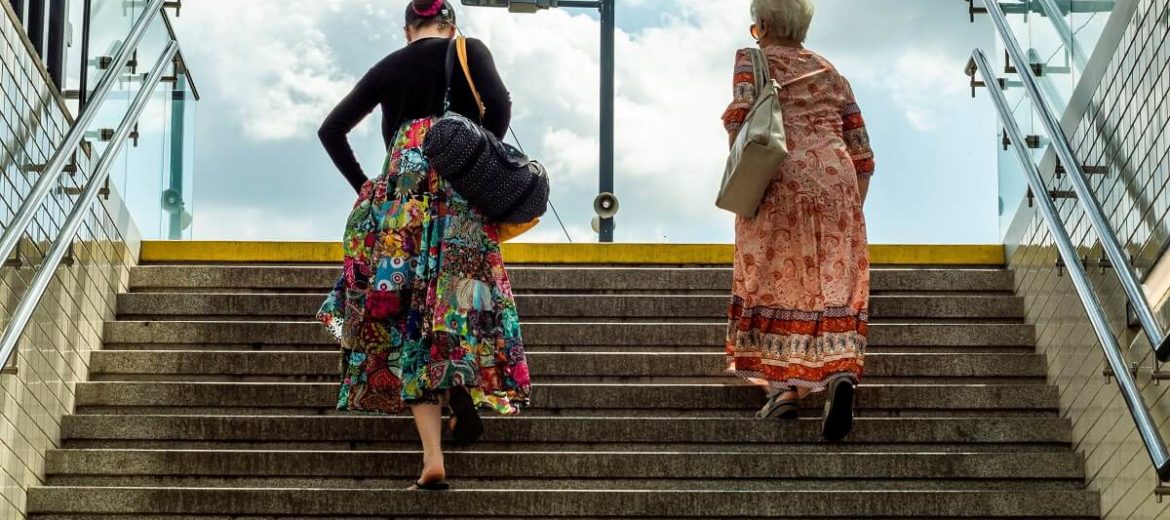
You can walk around for hours without a problem, then suddenly you encounter a flight of stairs and your knee hurts. Maybe it only hurts when going down, or maybe it hurts going in both directions. This is not uncommon, since climbing and descending stairs puts a different type of stress on your knees than other activities. It requires a single knee to support much of the body’s weight while in a bent position. This puts extra demand on the muscles and structures surrounding the knee.
Feeling knee pain on stairs doesn’t necessarily mean there’s serious damage. It can be related to irritation around the kneecap, muscle weakness, overuse, arthritis, or a change in the way your hips, knees, and ankles are working together.
The Reason Stairs are Harder on Your Knees
Walking on a level surface doesn’t require much knee bending, but stairs require considerably more. This puts a different type of pressure on your knee, quadriceps, and other muscles controlling your leg.
When you bend your knee, the kneecap moves within the groove at the end of the femur, placing a greater load on your patellofemoral joint. Activities like climbing stairs, squatting, and other knee-bending activities are often cited as causes of patellofemoral pain. Stair climbing in particular is referenced by the Journal of Orthopaedic & Sports Physical Therapy as an activity that loads the patellofemoral joint while the knee is flexed1.
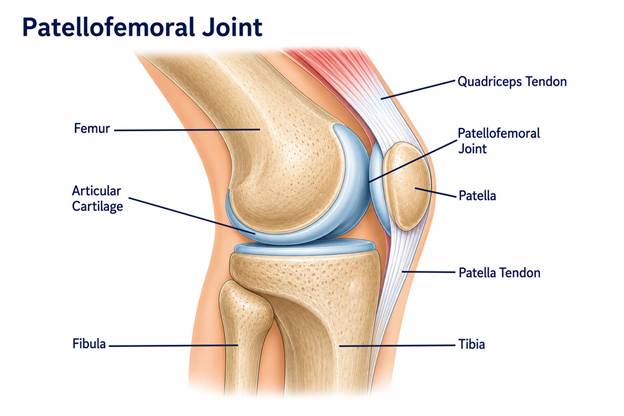
Your knee may have more difficulty with stairs simply because the stairs are asking more of it. Since your knees are complicated structures composed of many parts, there are many things that can contribute to pain. There is, however, a likely suspect.
The Most Common Possibility: Patellofemoral Pain
While not the only possibility, patellofemoral pain syndrome (PFP or PFPS) is a common source of this type of knee pain. Sometimes called “runner’s knee”, PFP can affect anyone, regardless of lifestyle or activity level. Symptoms of this type of pain can include:
- Dull or aching pain in the front of the knee
- Pain behind or around the kneecap
- Sometimes grinding, popping, or crackling
This type of pain is often experienced while climbing or descending stairs, while squatting or lunging, or after sitting for a long time with your knee bent. While specific causes of PFPS can vary, it often results from excessively weak muscles, a sudden change in your activity level, poor form while running or jumping, and sometimes just the natural shape of your knee. If your kneecap doesn’t fit naturally into the groove of your thighbone, this can lead to PFPS without any additional strain on your knee2.
Weak Hips or Thigh Muscles Can Change the Load on Your Knee
Our bodies are very complex systems in which body parts are influenced by other body parts. The knee is no exception. It does not operate independently; instead, it can be affected by your hips, thighs, ankles, or feet. Muscle weakness in these other areas can contribute to pain in your knees. For example:
- Quadriceps: Help straighten the knee and control bending while descending.
- Gluteal/hip muscles: Help control the position of the pelvis and femur.
- Calf and ankle muscles: Adequate ankle movement also affects how the body moves over the foot.
These and other muscle groups play a role in the amount of stress placed on your knees when climbing and descending staircases. Sometimes the solution to knee pain is strengthening the muscles of your core and lower body to keep so much stress from targeting your knees while they’re bent and supporting your weight.
Overuse or a Sudden Increase in Activity Can Contribute
Tissues in your body adapt to load over time. If you are an athlete or maintain an especially active lifestyle, your tissues will be adapted to dealing with greater stress than if you lead a less active, more sedentary life. This means that a sudden change in frequency, intensity, or duration of activity can temporarily exceed what your body is prepared to tolerate.
If you are experiencing knee pain in certain situations after making a change in your regular activities, this may be a contributing factor. Examples of changes can include:
- Starting a walking program
- Suddenly adding hills to an existing program
- Running more miles
- Taking up pickleball
- Doing more squats or lunges
- Climbing ladders
- Yard work
- Vacation involving lots of walking or stairs
Unusually repetitive or suddenly increased activities can place extra stress on your knees. While this extra stress may not be noticeable in many situations, an activity like climbing or descending stairs may put your knees in position for the consequences of this extra activity to become obvious.
What Can You Do About Knee Pain on Stairs?
There are many things that can contribute to knee pain on stairs. Several are mentioned above, but other possibilities can include arthritis or an injury. It’s important to keep in mind that articles like this are not a tool for diagnosing your pain. There are situations in which your knee pain should be followed by a professional medical evaluation.
You should consider the possibility of a meniscus injury if your symptoms begin suddenly after:
- Twisting
- Pivoting
- Falling
- A sports injury
- Another clear traumatic event
Other symptoms that may be concerning can include swelling, catching or locking, or a sensation that the knee is giving way. The Mayo Clinic cites pain, swelling, difficulty moving, and giving-way sensations among possible features of a torn meniscus3.
If you have any questions at all about the possibility of an injury, get a medical evaluation as soon as possible. In most cases, though, this type of pain does not come on suddenly and does not immediately follow a traumatic event. In these cases, there are often some simple things you can do on your own to combat knee pain on the stairs. Some examples include:
- Temporarily reduce the aggravating load.
If you’ve dramatically increased activity, try backing off a bit rather than repeatedly provoking the pain. - Keep moving within a tolerable range.
Unless there’s an acute injury or medical reason to avoid activity, total inactivity usually isn’t the goal. - Use the railing when necessary.
This can be especially helpful while symptoms are significant. - Don’t assume stretching is the only solution.
Some problems respond more to strength and movement training. - Address the whole leg.
Hip, knee, ankle, and foot mechanics may all need consideration. Work to keep them all strong and mobile.
Knee pain that accompanies every stair climb can have a serious impact on your quality of life. This is especially true if you have to climb or descend stairs regularly at home or at work. Even a few short stairs climbed repeatedly every day can be a burden when they cause pain.
If you are dealing with recurring knee pain that seems to follow you up and down every staircase, reach out to a qualified physical therapist for an evaluation. A professional evaluation will help you identify the underlying cause of the pain and help you build the strength, mobility, and flexibility you need to overcome it and avoid it in the future.
Sources
- Willy, Richard W., et al. “Patellofemoral Pain.” Journal of Orthopaedic & Sports Physical Therapy, vol. 49, no. 9, Sept. 2019, pp. CPG1–95, https://doi.org/10.2519/jospt.2019.0302.
- “Patellofemoral Pain Syndrome (PFPS) | Cleveland Clinic.” Cleveland Clinic, 2018, https://my.clevelandclinic.org/health/diseases/17914-patellofemoral-pain-syndrome-pfps.
- Mayo Clinic Staff. “Torn Meniscus – Symptoms and Causes.” Mayo Clinic, 6 Jan. 2022, https://www.mayoclinic.org/diseases-conditions/torn-meniscus/symptoms-causes/syc-20354818.


